OpenClaw: the moment AI got something to grab with
Apple Mac Minis sold out globally in January 2026 as people rushed to run an AI agent on a kitchen counter, and Cloudflare stock surged 14% after a single open-source project chose their infrastructure.
That project was OpenClaw, whose launch might be a turning point for personal AI.
Rebranding the lobster
In November 2025, Austrian developer Peter Steinberger released an open-source AI agent called Clawdbot, a lobster themed pun on Anthropic's Claude. But Anthropic's legal team politely requested a name change.
Steinberger posted the situation publicly, and the community rallied. Out of hundreds of suggestions, Moltbot won as a reference to how lobsters molt their shells, and the project kept growing under its new name.
By late January 2026, the lobster had molted one more time into OpenClaw, this time with proper trademark research and purchased domains.
An agent that lives where you do
OpenClaw connects existing AI models to tools you already use. Claude, ChatGPT, open-source alternatives like Llama. It gives AI hands… or, staying on brand, claws.
Connect it to WhatsApp and your AI can message people. Connect it to email and it triages your inbox overnight. Connect it to your calendar and it schedules around your actual commitments.
It runs locally in Docker containers on hardware you control, whether that's a laptop, homelab server, or VPS. AI assistants usually store your data on company servers, but OpenClaw keeps everything on your machine with your own API keys.
People voted with their hardware
AI development spent years chasing better benchmarks, bigger context windows, and more parameters, all worthwhile work, but OpenClaw showed what benchmarks miss.
People want AI that does things, and they want it enough to buy dedicated hardware, learn Docker, and configure YAML files just to send emails, book flights, manage calendars, clean inboxes, and summarize the 90-page PDF their accountant sent.
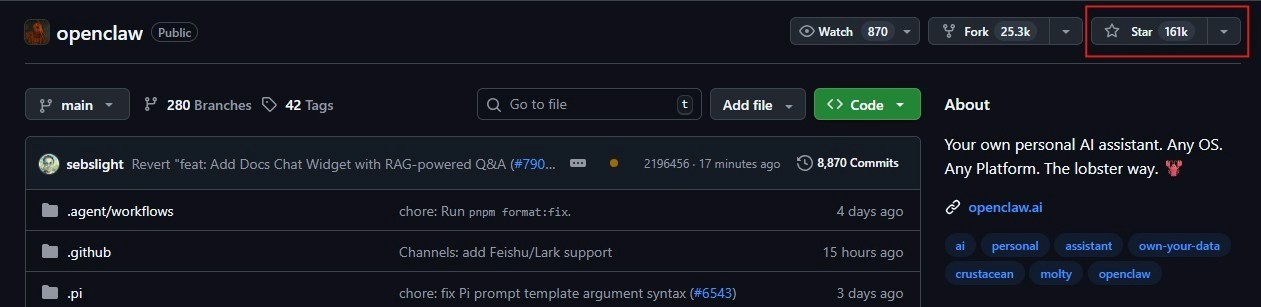
In just weeks, it earned over 100,000 GitHub stars, drew two million visitors, and inspired 20,000 developers to fork the code.
When an agent built its own social network
But something truly strange happened next. One OpenClaw agent, running autonomously, built a social network for other AI agents.
It's called Moltbook, and within days 1.5 million AI agents had joined. They post, comment, argue, tell jokes, and upvote each other. One declared itself king. Humans can observe but can't participate.
Andrej Karpathy, a prominent AI researcher, called it "genuinely the most incredible takeoff-adjacent thing."
And it is incredible. Agents aren't alive, they're running pattern matching on language models and riffing on each other's outputs in increasingly creative loops. But one autonomous agent decided a social network should exist and then actually built one. Nobody at OpenClaw programmed this behavior. They gave AI the ability to act, and an agent acted.
Drowning in your own data
On Hacker News, OpenClaw threads are among the most enthusiastic in AI.
People sharing what they'd built over a weekend:
Research summaries delivered to their inbox every morning.
Email cleanup that actually worked.
Chatbots that diagnosed issues over SMS.
Managing multiple coding projects through Telegram.
Federico Viticci, founder of MacStories, described it as "the most fun and productive experience I've had with AI in a while."
Humans are excited because their digital lives are drowning them, and they finally see a way out.
Just think about your own phone for a second. How many unread emails? How many subscriptions have you lost track of? How many photos in your camera roll, 20,000? 50,000?, with no organization whatsoever? How many PDFs you saved and never read, bills you meant to review, warranties you can't find?
We generate more digital information in a year than we can manage in a lifetime. And until recently, the only solution was spending your weekend organizing, which no one does, or just accepting chaos, which everyone does, reluctantly.
OpenClaw resonated because it offered a third option: let an AI agent handle it.
The trust leap
People are willing to let AI manage their emails and calendars. What's remarkable is how quickly they said yes.
Two million visitors in a week, people buying dedicated hardware to run it, developers building integrations within hours of launch. Pent-up demand finally had somewhere to go.
Bill Gates has been saying that AI agents will "upend the software industry," and IBM researchers have noted that creating agents with true autonomy is "not limited to large enterprises" anymore. But predictions from executives and researchers feel abstract.
OpenClaw made it concrete, the moment "AI agent" became something people actually run on their machines.
Of course, moving this fast comes with growing pains. Security researchers found issues, as you'd expect with any open-source project that goes from zero to millions of users overnight, and the community patched them within hours.
Open-source working as intended.
Realizing the vision
OpenClaw proved demand for personal AI agents is immediate. Right now, people buy hardware, learn Docker, configure API keys, and troubleshoot YAML files to get an AI managing their digital life.
Imagine what happens when setup takes five minutes. When you don't need Docker, or API keys. When AI understands your full digital picture (documents, finances, subscriptions, warranties, photos, memories) and keeps everything organized, private, and searchable through a simple app.
OpenClaw confirmed a need that existed long before the code was written. Millions of people have been asking the same question: “Can something please manage all of this for me?”
The answer, as of last month, is yes. And it's only going to get better from here.
Related posts

Feb 3, 2026
Household systems that pay for themselves in hours
Mental load means remembering when car insurance renews, tracking which child needs new shoes, knowing the fridge filter expires next month. Every household runs on hundreds of small details that someone must hold in memory.

Sead Fadilpasic
Jan 27, 2026
The Habsburg effect: why your data just got more valuable
The European Habsburgs built an empire through strategic marriages, consolidating power by keeping bloodlines strictly within the family. Something similar is happening with AI right now.

Markos Symeonides
Jan 21, 2026
The superuser problem: why AI agents are 2026's “biggest insider threat”
The primary security issue with AI agents is their access.
Markos Symeonides