The information in your life should work as hard as you do
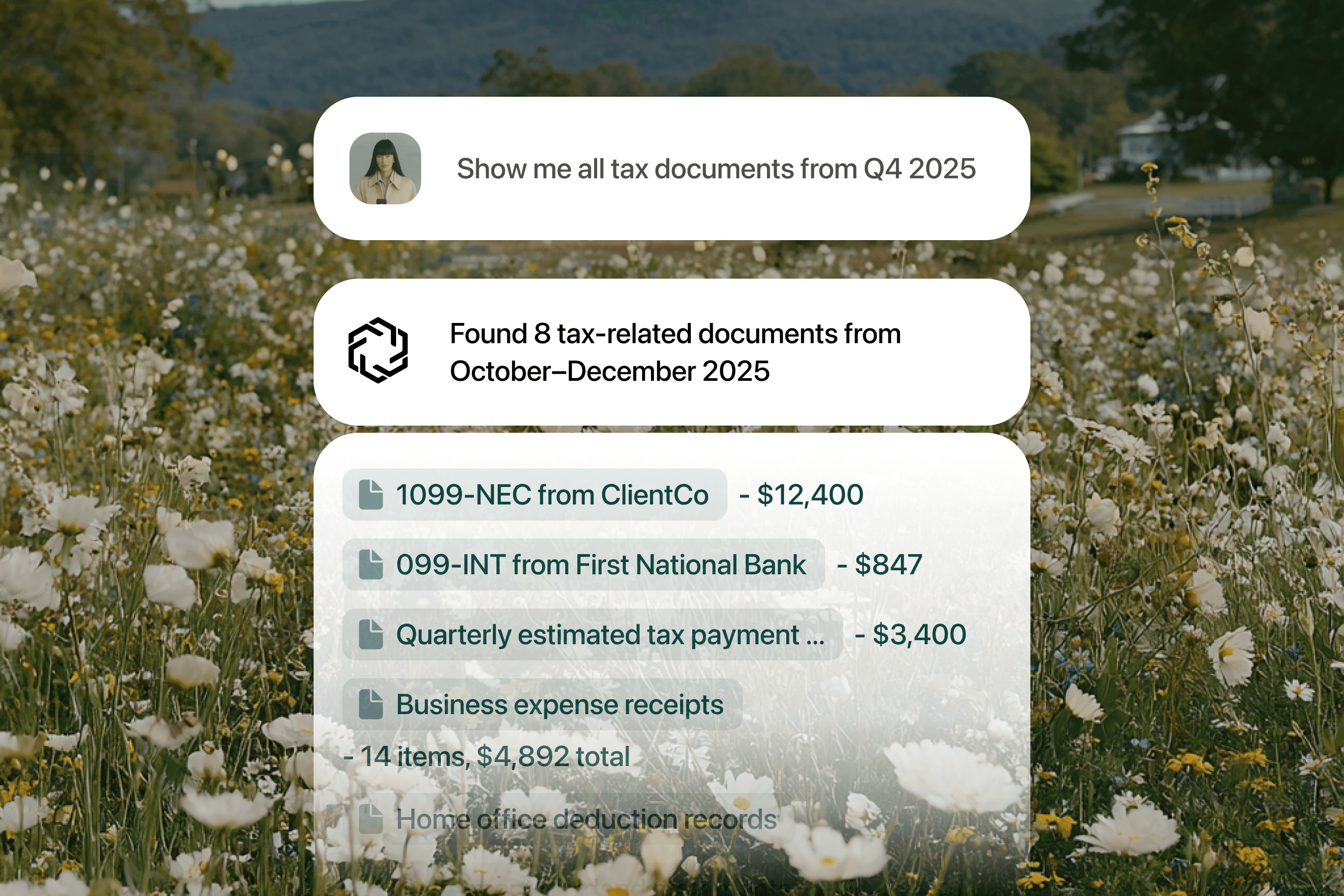
For years, we’ve moved files online. Cloud storage, digital safes, document managers. Files sit there until we need them. That’s storage, but storage alone doesn’t make information usable.
At MyVault, we are building a private AI system that connects personal information without exposing it. Not another place to upload files, but a way to keep them structured and accessible when you need them.
Storage alone isn’t enough
Digital storage replaced paper piles, but the problem stayed. Thousands of files sit in folders with vague names or disappear into downloads. A scanned receipt, a warranty PDF, or an old bank email only exist if you remember to check.
We spend time tagging and filing, but the documents stay dormant. They remain disconnected until you miss a renewal or need a quick answer.
From filing to usable data
Traditional tools require you to adapt to the software by choosing folders and remembering where everything lives. MyVault uses models to convert these unstructured documents into structured data you can query.
When a file enters the vault, the system extracts entities such as assets, policies, accounts, dates, and amounts. These outputs link to existing records. This creates a structure based on relationships, not storage locations.
Without this extraction, personal information remains stuck in traditional search and folder structures.
Maintaining continuity and verifying data
Traditional storage treats documents as separate snapshots. MyVault treats each asset or entity as a persistent record. When a new document arrives, the system extracts the data and updates the relevant entity immediately.
Conflicting updates are flagged while historical entries are preserved. This builds a timeline of changes, keeps the most recent verified information at the top, and lets you see exactly when and why a value changed.
All linked entities stay connected, so your data is accurate and actionable.
MyVault intelligence vs. old document tools
Here’s how MyVault differs from traditional document tools:
Feature | Old document tools | MyVault |
Primary function | File storage and retrieval | Data extraction and connection |
Input format | Files treated as whole objects | Files broken into structured records |
Organization method | Manual folders and tags | AI entities and relationships |
Search behavior | Keyword matching | Relationship based queries |
Cross document context | Not preserved | Stored at the data level |
User effort | High and ongoing | Limited to upload |
System behavior | Passive | Runs checks across connected records |
Handling unstructured data | Minimal | Core capability |
Privacy model | Administrative access | Zero trust, user held keys |
Result | Archived files | Queryable personal data |
The knowledge graph: answers, not just files
The knowledge graph stores extracted entities and their relationships. Each entity exists once and links to all related documents, providing a direct connection between structured data and the original evidence.
This structure makes your information usable, not just stored.
Agents on the same intelligence layer
MyVault runs three agents:
Insurance Agent extracts and checks details related to policies, coverage, and claims
Asset Agent tracks ownership records, valuations, warranties, and maintenance
Finance Agent accesses payments, subscriptions, and spending records
Agents share the same data. A policy renewal updates coverage records, asset exposure, and expense projections at the same time. Because every item is linked to its proof, the agents can reference the original documents to confirm any detail.
Ask MyVault
Questions follow these stored relationships. Ask about total car spending and MyVault pulls payments from finance, purchase records from assets, and claim payouts from insurance. Answers come from structured data, not document search, with sources always accessible.
Why connected data matters
When information is linked and verified, it changes how it can be used. Receipts, policies, and other documents become instantly queryable. Need total car expenses for the year? Or whether a home insurance policy covers a new repair?
MyVault can provide precise answers because every entity, relationship, and update is tracked. You see the current status without searching through folders. Connected data turns your documents from static files into actionable intelligence, saving time, reducing errors, and giving confidence that nothing is missed.
Private by design
The word “AI” can concern people with personal files. Here is how MyVault handles your files:
You hold the encryption keys. We use a zero-trust architecture, which means the technical design prevents us from accessing your files. We do not have a method to bypass your security or view the contents of your vault.
Analysis runs in secure 30-day windows. When the system extracts data from a document, it happens in a temporary environment. This environment exists only to perform the task. After 30 days, processing data is wiped from our servers. Nothing stays behind.
Your data is not used for training. The models used by MyVault do not learn from your personal information. Your records are not fed back into public datasets or used to change the system for other users.
Our progress
We’re a small team of builders. We believe everyone deserves the same intelligence that big companies have, with the privacy of a physical safe.
MyVault acts as your digital brain. It keeps the details you might forget, so your family has the information they need during an emergency.
Follow the build
Starting this month, we are launching a monthly letter to share the logic behind MyVault. We will explore the intersections of private AI, agentic systems, and human-centered intelligence.
Follow our build and see how private AI makes your information useful.
Related posts
Feb 10, 2026
OpenClaw: the moment AI got something to grab with
Apple Mac Minis sold out globally in January 2026 as people rushed to run an AI agent on a kitchen counter, and Cloudflare stock surged 14% after a single open-source project chose their infrastructure.

Markos Symeonides

Feb 3, 2026
Household systems that pay for themselves in hours
Mental load means remembering when car insurance renews, tracking which child needs new shoes, knowing the fridge filter expires next month. Every household runs on hundreds of small details that someone must hold in memory.

Sead Fadilpasic
Jan 27, 2026
The Habsburg effect: why your data just got more valuable
The European Habsburgs built an empire through strategic marriages, consolidating power by keeping bloodlines strictly within the family. Something similar is happening with AI right now.
Markos Symeonides